
Your churn reason codes record where the loss was noticed
Pull up the reason codes on last year's lost accounts. You'll probably see "budget," "moved to a competitor," "champion left," and a long tail of "other." Someone on the account team chose each one at the point of cancellation, usually in a hurry and usually from a dropdown.
Those codes tell you where the loss was noticed, which is often months after it began.
The renewal is where losses get recorded
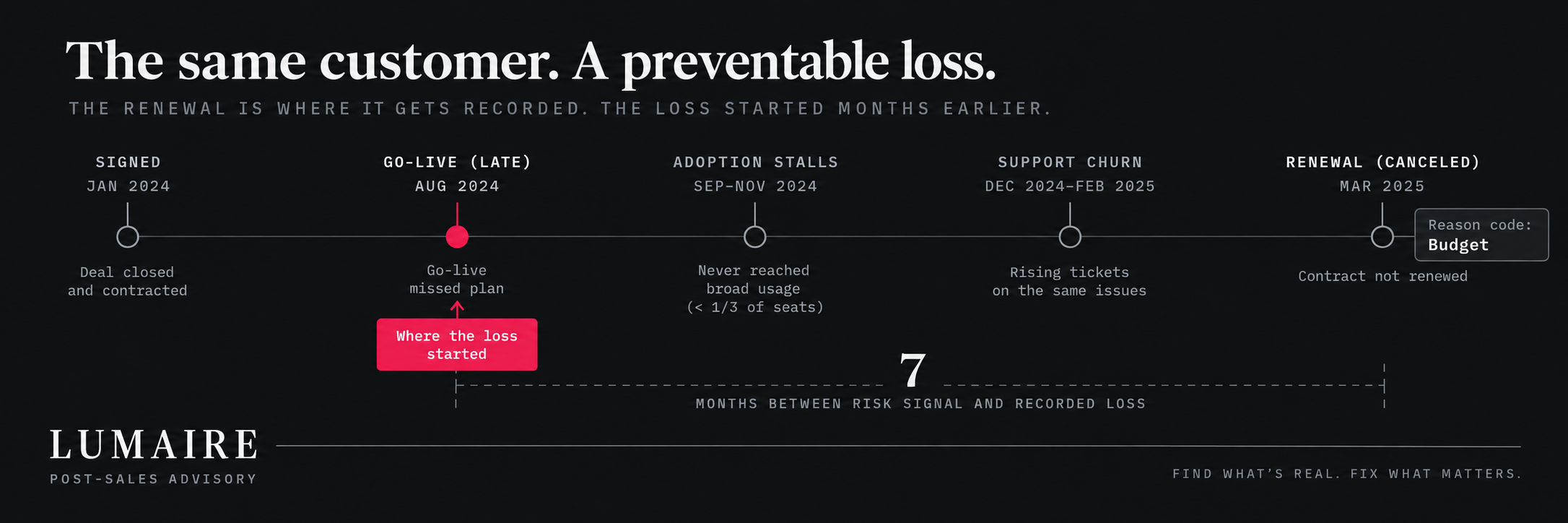
A customer that waited seven months to go live and never got past a third of its seats may eventually cancel at renewal. The CSM will log it as budget, because that's what the customer said on the call. The implementation delay that started it never appears in the record.
This is how customer success teams can end up accountable for losses whose underlying risk was created months earlier. It's also why retention plans built on reason codes tend to fix the wrong thing.
Re-attribute the losses
The exercise takes a few days and needs no new tools. Take the last four quarters of lost and contracted accounts, up to 25 of them. For each one, walk the account's history forward from the signature. Check the implementation timeline against the plan, then usage at 30 and 90 days after go-live. Look at support volume and whether the same issue kept coming back, and read the sales notes for what was promised.
Then assign each loss to the earliest stage where the evidence shows material risk appeared: implementation, adoption, support, product, or sales fit. Record the cancellation reason separately. Weight the attributed losses by ARR.
Capture two dates while you do it: when the first observable risk appeared and when the loss was recorded. The median gap between them is your revenue risk detection lag. If that number is seven months, your retention problem isn't just that customers are leaving. It's that the business is seeing the risk seven months too late.
If a third of lost ARR traces back to implementation, the fix is in the first 90 days of the customer relationship, and adding CSM headcount won't touch it. If a large share traces to sales fit, the conversation moves to deal qualification and the terms being signed.
Test the health score on the same list
While you have the list, check what your health score said about each account 90 days before the loss. A score that was green on most of them isn’t predicting retention risk. Find out which inputs kept those accounts green, and whether you’re measuring customer activity instead of realized value.
At ShipHero I designed team-level health scoring tied to retention accountability, and TSIA later benchmarked the results in the top 15% of the industry for expansion and low churn. Logo churn ran at 2.0% against an industry median near 9%.
Look at where expansion actually comes from
McKinsey's research on NRR found that companies with the most developed value realization and adoption journeys produce NRR around seven percentage points higher than peers. Adoption and expansion are one motion, even when they report to different leaders.
Two checks make this concrete. First, what share of last year's expansion started from a defined usage trigger, such as a seat threshold or a module reaching steady use? If most of it came from ad hoc check-ins, expansion depends on who happened to call. Second, before an add-on pitch goes out, what is the account's utilization of the license it already owns? Selling a second module into an account using a fraction of the first one tends to produce a contraction at the next renewal.
Two risks that hide in plain sight
Executive sponsor turnover is the quietest churn signal there is. When the person who bought your product leaves, their replacement has no stake in the decision. Check how many of your top accounts have more than one executive relationship, and how long it took you to learn about the last sponsor change.
The other risk sits in the deals themselves. Compare first-year churn on deals signed with custom terms or deep discounts against standard deals. If the non-standard deals churn at a higher rate, sales incentives are sending risk downstream, and post-sales is absorbing it.
Who owns the number
None of this sticks unless someone owns the renewal and expansion number for every account and gets paid for moving it. When CSMs and account executives dispute credit on expansion, the customer usually feels it first. I've designed comp plans at ShipHero and Rackspace, and clear ownership belongs in the plan document itself.
If you want a quick read on where your revenue team stands, the post-sales scorecard has a revenue section built around these questions. It takes about six minutes.
