
The dangerous assumption isn't that your data is dirty. It's that everything the agent needs to know exists in the data at all.
Gainsight connected its customer health data into Salesforce Agentforce and Slack on September 15. CEO Chuck Ganapathi described the point of the work plainly. The integration exists to give agents "the context to see how a customer is adopting a product." Read that as a clue about where the hard part has moved. The agents are arriving faster than the context they need. For most companies, getting that context clean, connected, current, and trustworthy was the difficult work long before agentic AI showed up. That gap is showing up in research: McKinsesy found that eight in ten companies cite data limitations as a barrier to scaling agentic AI.
I watched a version of this play out before AI sat anywhere near the room. I rebuilt the implementation function at a compliance-heavy SaaS company running 33 clients on the platform. What protected those renewals had nothing to do with tooling. It came from knowing which account was three weeks out from a board review, and whose champion had gone quiet and started taking recruiter calls. That knowledge lived in a handful of people's heads and in data we spent months making trustworthy before anyone could act on it. Point an agent at the version of that data we started with and it would have produced confident, wrong recommendations at a speed no human could match.
Here is the mechanism worth sitting with. An agent does not know your customers. It knows the representation of them you make available: CRM records, product telemetry, support history, conversations, documents, health scores, and whatever else you have connected and made retrievable. When the CRM cannot see your support tickets, and the health score runs on login counts, the agent reasons from a picture where a customer who logs in daily and files three furious tickets a week looks healthy. If that representation is incomplete, stale, or wrong, the agent does not magically recover the missing reality. It reasons from the context it was given. It may surface an expansion play into an account that is one escalation away from leaving. The model may have done exactly what you asked. The picture you gave it was never true.
Picture the simplest version of that. An account logs in every day, so the usage signal reads healthy, and the agent recommends a well-timed upsell. What the agent cannot see is that the daily logins are one frustrated admin re-checking a report that keeps breaking, and that the economic buyer stopped showing up to the business reviews back in June. A CSM who knew the account would never pitch that upsell. The agent, working from the clean-looking half of the picture, flags the account for expansion or triggers the next step, putting the renewal in worse shape than it was before anyone automated anything.
Where the context actually lives
Some of the most consequential renewal context never makes it into a structured field. A champion's enthusiasm cooling across two quarters. A reorg that moved your buyer three levels down the org chart. A services team quietly absorbing custom work to keep an anxious account calm, which is one of the clearest risk signals there is and almost never gets logged, because logging it means admitting the account is shaky. I call that last pattern the silent handoff, when what a company knows about a customer walks out the door faster than anyone moves it into a system. An agent cannot reconstruct any of it from a health score. It works with what you handed it, and the parts you never captured are the parts that were quietly carrying your forecast.
That gap has a cost that compounds. Adoption decay can run underneath a green dashboard before the headline usage metric visibly drops. A human who knows the account may catch the change in behavior, relationships, or sentiment before the score moves. An agent reading the same dashboard sees green, recommends accordingly, and now the wrong call arrives faster and more often than it used to.
This is not just a customer-success problem. McKinsey reported this year that while nearly two-thirds of enterprises had experimented with agents, fewer than 10 percent had scaled them to deliver tangible value. Eight in ten cited data limitations as a barrier to scaling. The model is increasingly not the bottleneck. The environment it has to reason inside is.
What the teams getting value already did
The pattern emerging from companies trying to scale these tools is less glamorous than the agent demos. The data foundation comes first. The problem is not theoretical. A 2026 MIT Technology review Insights study found that AI systems could access only 45 percent of enterprise data on average, while 55 percent of executives said their current data systems were preventing them from scaling agentic AI.
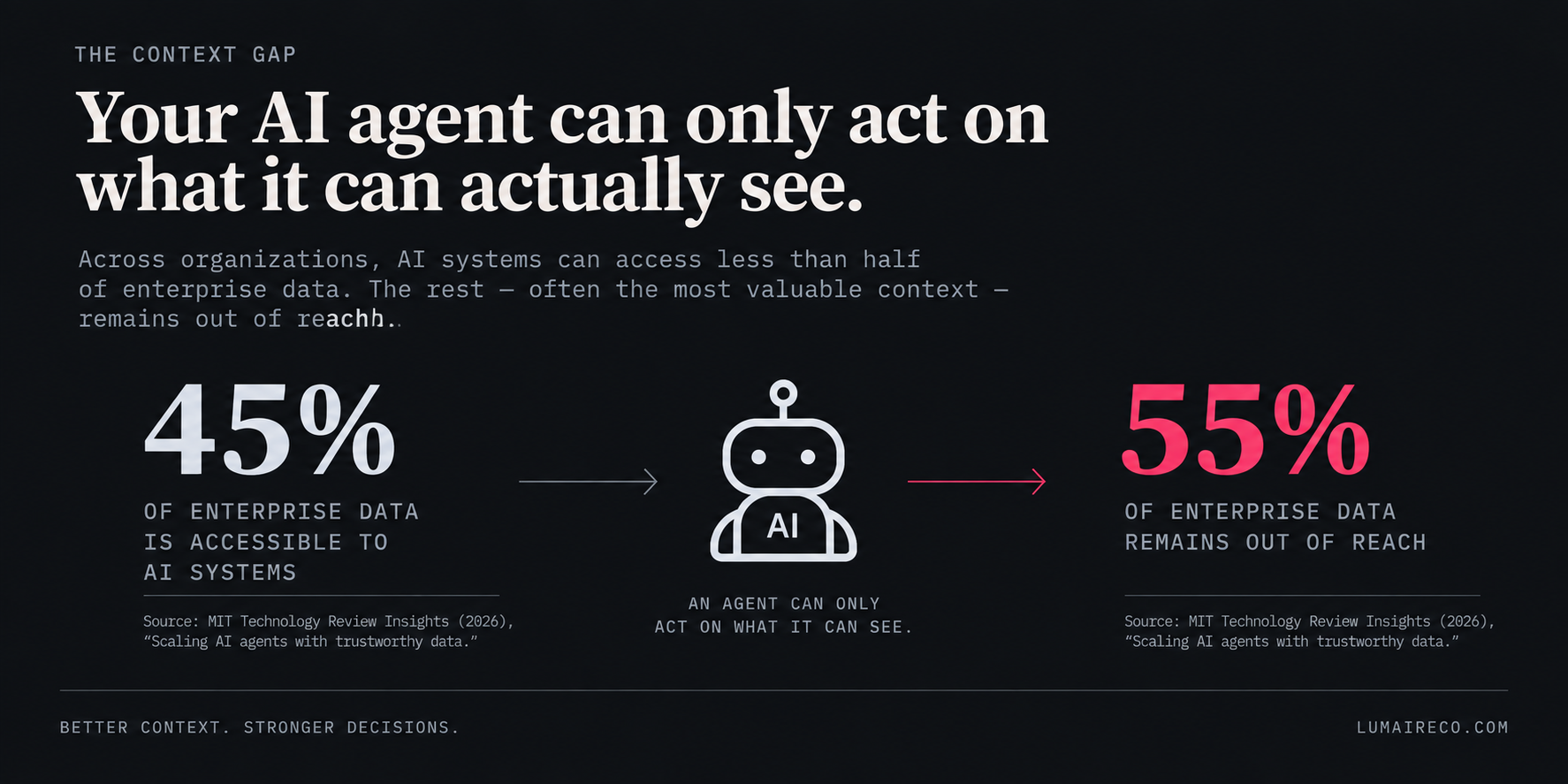
Product usage, support history, CRM records, and other customer signals have to resolve into a representation the agent can reliably retrieve and interpret. The health model has to be tested against actual outcomes rather than assumed to be predictive. And the signals that trigger action need clear ownership, lineage, and definitions. Only then does speed become an advantage instead of a multiplier on bad assumptions.
Buying the agent to skip that step produces the reverse. You learn, at machine speed and across the whole book, how little your data actually knows about your customers. The tool did not create that problem. It industrialized one you already had.
The check to run before the budget gets spent
If you own retention and someone just set an AI budget on your desk, the first work is not vendor selection. It is a short audit that answers a few questions in plain language:
Does the system scoring customer health read from the same place your support and product data live, or is it inferring from a thin slice of behavior?
When an account churned last year, did anything in the record shift before the cancellation, or did the first real signal arrive with the notice itself?
Where does customer knowledge currently sit that no system would capture if the person holding it left this week?
How old can a signal get before you would no longer trust a person to make a decision from it?
Access alone is not enough. The context has to be accurate, relevant, and current enough for the decision being made.
Those answers tell you whether an agent will extend your team's judgment or multiply its blind spots. In the companies I have worked in, the honest version of that audit took weeks and surfaced things nobody wanted on a slide. It was also what separated a retention function that could see around corners from one that spent its quarters reacting to cancellations.
The agents will keep improving, and quickly. That was never the open question. The question the integration announcements keep stepping around is whether the context you would feed one is worth acting on in the first place. Get that right and the agent earns every dollar. Skip it and you have bought a faster, more expensive way to be wrong about the customers you most need to keep.
I work with post-sales leaders on exactly this, starting with a diagnostic that tests whether the data behind your retention forecast can hold the decisions you are about to automate. If that is the question sitting on your desk, take a few minutes to complete the post-sales scorecard.
